The Nervous System Is Not a Behavior Problem
Why regulating your child starts with understanding what is actually happening inside their body
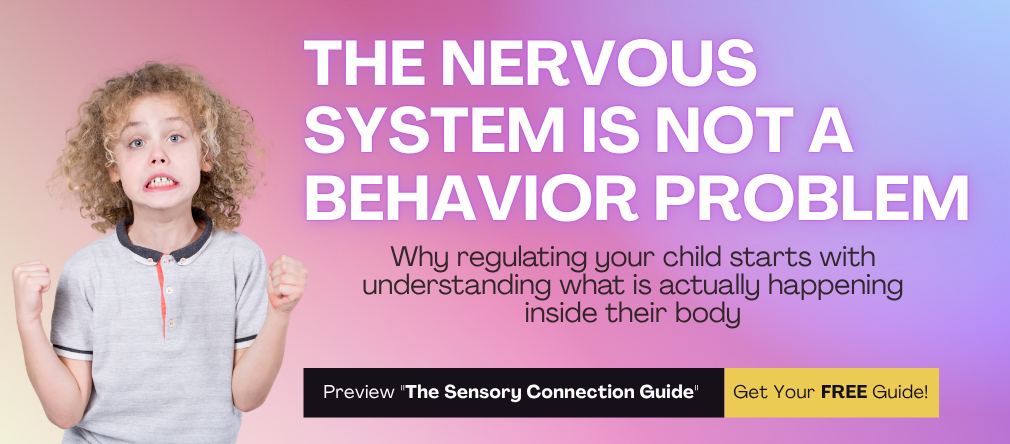
If you have ever watched your child fall apart over something that seemed small — a sock seam, a loud room, a change in plans — and wondered what you were missing, this is for you.
The answer is almost never a behavior problem. And it is almost never a parenting problem. What you are most likely watching is a nervous system that is working exactly as designed, just responding to a world it has not yet learned to navigate safely.
Understanding the difference between a nervous system response and a behavioral choice is one of the most powerful shifts a parent can make. Once you see it, you cannot unsee it.
What the Nervous System Actually Does
Your child's nervous system is constantly scanning the environment for information. It is processing sound, light, texture, movement, and social cues all at once, before any conscious thought happens. This process is called neuroception, and it determines whether your child's brain registers safety or threat at any given moment.
When the nervous system detects what it interprets as a threat, it activates a survival response: fight, flight, or freeze. This is not a choice. It is biology. And critically, the threat does not need to make sense to anyone else. It just needs to feel real to that nervous system.
A nervous system in survival mode cannot learn, cannot reason, and cannot comply. It is trying to survive.
This is why strategies like reasoning, consequences, or redirecting often fail in the middle of a meltdown. The rational brain is offline. If you want to understand what is actually happening during those moments, the breakdown between a meltdown and a behavioral tantrum matters enormously — I wrote about this distinction in depth here. You are not dealing with a behavior. You are dealing with a storm.
The Three States Every Parent Should Know
Polyvagal theory, developed by Dr. Stephen Porges, gives us a simple framework for understanding why children can seem like completely different kids in different situations. There are three states:
The Safe and Social State
This is your child at their best. Calm, curious, engaged, and flexible. Their nervous system has assessed the environment as safe. Learning happens here. Connection happens here. This is the state we are always working toward.
The Fight or Flight State
This is activation. Your child may look angry, aggressive, bouncy, loud, or chaotic. Their nervous system has detected a perceived threat and mobilized energy to deal with it. This is the meltdown, the outburst, the child who cannot sit still.
The Freeze or Shutdown State
This is collapse. Your child may go quiet, flat, or disconnected. They might seem checked out, emotionally numb, or unreachable. This can look like defiance or laziness, but it is often the opposite: it is the nervous system withdrawing to protect itself.
Most discipline strategies are designed for children in the safe state. They fall apart entirely in the fight, flight, or freeze states because they address behavior, not biology.
What Triggers a Nervous System Response?
Triggers vary widely from child to child, which is why sensory processing is so individual. Common nervous system stressors in children include:
Sensory input that is too intense, too unpredictable, or too prolonged (loud environments, bright lights, crowded spaces, certain textures)
Transitions and unexpected changes to routine
Feeling misunderstood, unheard, or shamed
Hunger, fatigue, or illness, which reduce the nervous system's capacity to cope
Social overwhelm, particularly in children who process social information differently
Cumulative stress that has built up across a day, even when individual stressors seemed small
One of the most important things to understand is that the nervous system does not reset instantly. A child who has been dysregulated in the morning may still be operating with a depleted capacity for regulation by the afternoon. The bucket was already full.
Regulation Is a Skill That Has to Be Built
Children are not born with the ability to self-regulate. That capacity develops gradually, with the help of co-regulation: the experience of being with a calm, attuned adult who helps their nervous system settle.
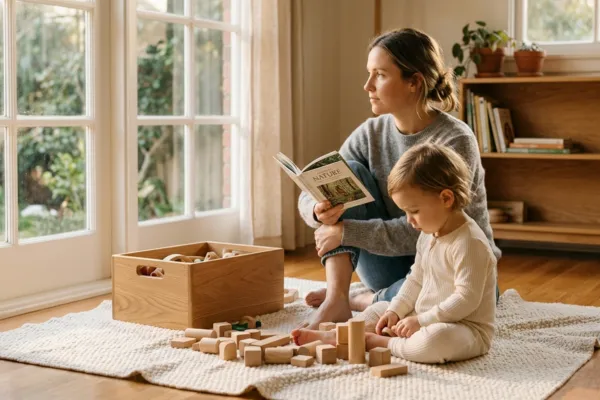
Co-regulation is not about fixing every hard moment. It is about being a safe presence. Your calm nervous system literally sends signals to your child's nervous system that it is safe to come down.
This is why the phrase 'calm down' rarely works. You cannot tell a nervous system to stop responding. You can, however, create conditions where it no longer needs to.
What Co-Regulation Actually Looks Like
Lowering your own voice before asking your child to lower theirs
Sitting near them without demanding eye contact or verbal response
Using slow, steady movements and a soft tone
Offering a familiar sensory anchor: a weighted blanket, a preferred texture, a quiet space
Waiting. Regulation takes time, and rushing it often escalates it.
When Behavior Is Communication, Not Manipulation
A useful lens that I come back to in clinical practice again and again: behavior is communication from the nervous system. Every behavior your child displays is giving you information about their internal state, even when the behavior is hard to be around.
The child who hits is telling you they are overwhelmed and do not have the language or the regulation to express it differently yet. The child who shuts down is telling you the environment became too much. The child who melts down over a snack is usually not melting down over the snack.
When you shift from asking "Why is my child doing this?" to "What is my child communicating right now?" everything changes.
This does not mean behavior has no limits or that every response is appropriate. It means you address the root first, and the behavior second. Regulation is always the prerequisite.
Practical Places to Start
You do not need to overhaul everything at once. Here are a few grounded places to begin:
Start noticing patterns. Keep a simple log of when dysregulation happens most often. Time of day, environment, what came before. Patterns reveal triggers.
Build predictability into your daily structure. Transitions are easier when children can see what is coming. Visual schedules help, even for older kids.
Identify what regulates your individual child. Not what is supposed to work — what actually works for them. Some kids need movement. Some need quiet. Some need deep pressure. Start observing.
Work on your own nervous system. Your regulation capacity is your most powerful parenting tool. This is not a judgment, it is a biological reality.
Separate the moment from the lesson. During dysregulation is not the time to teach, consequence, or explain. Wait until the window of safety is open again.
A Final Note
Your child is not giving you a hard time. They are having a hard time. And the fact that you are reading this, looking for a better way to understand them, already puts you exactly where they need you to be.
If you are also navigating what this looks like inside a classroom setting, the dynamics shift in important ways. This post on sensory strategies for teachers covers how educators can apply a similar lens to classroom behavior — and it is worth sharing with anyone involved in your child's school day.