“I’m a Teacher, Not a Therapist; But My Classroom Feels Like Chaos. Now, what?”
Dear Teaachers,
If you’ve ever looked around your classroom and thought:
“I’m doing everything I can... but it’s still chaos.”
“I didn’t train for this.”
“How do I help this child without losing control of the rest?”
— then, you’re not alone.
And you’re not failing.
I want you to hear this from me, a pediatric occupational therapist who’s spent over 30 years working alongside educators just like you:
You don’t need to be a therapist, you just need the right tools.
– Dr. Shelley Margow
Let’s Start with the Truth
Most teacher prep programs don’t cover sensory processing, nervous system regulation, or how to respond when a child shuts down, runs out of the room, or melts down in front of 20 other students.
And yet, these are exactly the realities you’re expected to manage every day.
You're juggling curriculum, testing, communication with families, and now, sensory seekers, sensory avoiders, and kids with behavior patterns no one trained you to decode.
The system asked you to do it all, but gave you almost nothing to do it with.
So this isn’t an article about doing more.
This is about doing it differently… with support.
What You Might Be Seeing Isn’t "Bad Behavior," It’s a Sensory System in Distress
That student who chews on their shirt, the one who hides under the table, the one who seems to “act out” at the same time every day… their body might be asking for help in the only way it knows how.
A dysregulated nervous system doesn’t learn.
It protects.
When a child is overwhelmed by sound, light, movement, or even their own internal sensations, they don’t have access to the “thinking” part of the brain. That’s why traditional behavior plans often miss the mark, they treat the output without understanding the input.
Three Small Shifts That Make a Big Impact
You don’t need a therapy gym or a new certification to create a more supportive classroom. These three simple tools can help you start shifting from chaos to calm:
1. Movement Breaks Are Not a Luxury, They’re Regulation
Children (especially sensory-seeking or under-responsive ones) need movement to stay engaged and regulated.
Try:
A “movement station” in the back of the room with stretch bands or wall push-ups
3-minute chair yoga or jumping jacks between transitions
Sending a student to “deliver something” down the hall as a purposeful walk
These short breaks can reduce outbursts and improve focus.
2. Create a Safe Space, Not a Time-Out Corner
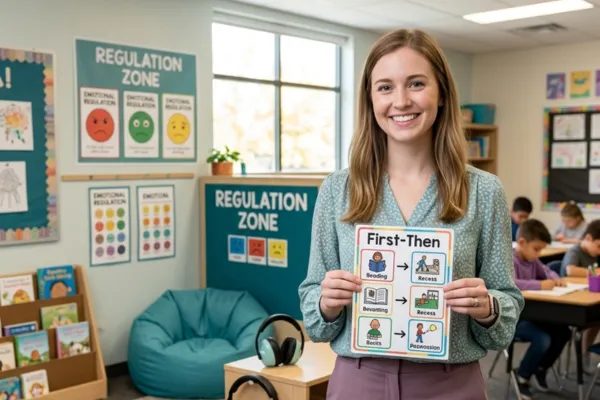
A regulation zone isn’t punishment. It’s prevention.
Try:
A small corner with headphones, a soft mat, and visuals (like emotion cards)
Let the student choose when they go (when safe), give them agency
Teach the class that everyone needs “brain breaks,” not just “troubled” kids
This reduces shame and encourages self-awareness.
3. Use Visual Tools, Not Just Verbal Instructions
Many neurodivergent students struggle with auditory processing, they hear your words but can’t organize them into action.
Try:
Visual schedules (with photos or icons)
First-Then boards (First: Math. Then: Coloring.)
Visual emotion scales (1–5 faces showing regulation to meltdown)
This bridges the gap between intention and understanding.
Real-Life Impact, Real Fast
One teacher I worked with had a student who would run out of the classroom every time she raised her voice, even slightly. She thought it was defiance. Turns out, he had severe auditory sensitivity due to past trauma and sensory integration difficulties.
After implementing a visual cue for transitions, adding noise-canceling headphones to her classroom toolkit, and starting each day with five minutes of heavy work (pushing a loaded cart), his running stopped.
Not because we “fixed” him.
Because we understood him.
You Are Already Enough, You Just Need the Next Layer of Support
You’re not a therapist.
You don’t have to be.
You’re a safe adult, a steady presence, a compassionate leader, and that’s the heart of healing for many of these children.
Want ready-to-use tools for your classroom?
Start with the free Sensory Checklist for Educators. It’s clear, quick, and helps you decode behavior through a new lens.