
Stop Calling It a Tantrum: Understanding Meltdowns Through a Sensory Lens
If you’re a parent or teacher who has ever watched a child crumble into tears, hit the floor, or spiral into what looks like a “tantrum,” you’re not alone.
But here’s the truth I wish every adult understood:
Most of what we label as “tantrums” are actually meltdowns, and meltdowns are not behavioral choices. They’re survival responses.
For many children, especially neurodiverse ones, the world is louder, brighter, tighter, faster, and more overwhelming than we realize. What looks like misbehavior is often the nervous system saying,
“I’m not okay.”
And when a child is dysregulated, discipline won’t work, not because the child is being defiant, but because their brain isn’t accessible for learning in that moment.
Let’s break this down through a sensory lens.
Tantrum or Meltdown? What’s Actually Happening in the Brain
A tantrum is a goal-oriented behavior.
A child wants something, a cookie, your attention, a toy, and they escalate to get it.
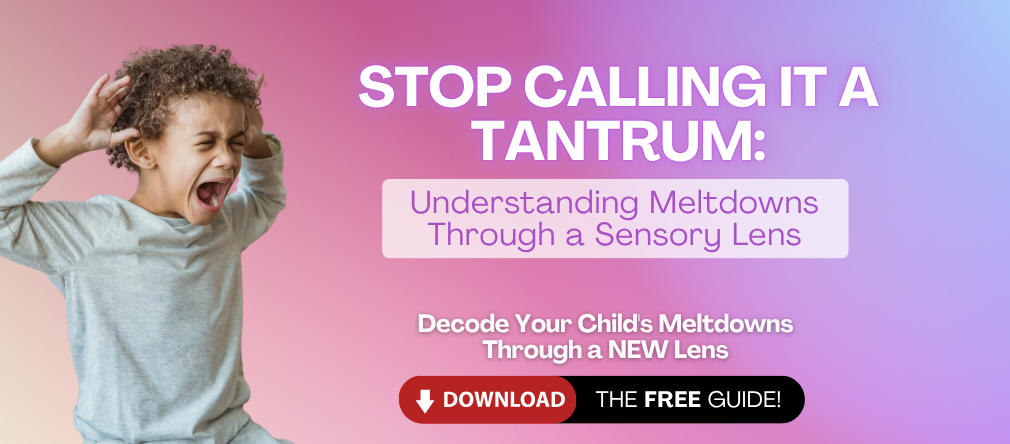
A meltdown, on the other hand, is a neurological overflow.
The child’s sensory system is overwhelmed, and the body goes into fight, flight, or freeze.
No amount of reasoning, consequences, sticker charts, or “use your words” will work during a meltdown because the brain is not in a state where it can respond.
This isn’t permissiveness.
It’s neuroscience.
What a Sensory-Driven Meltdown Can Look Like
Here are everyday examples I see constantly in my clinical practice:
1. A child crumbles in the grocery store.
To you, it looks like defiance.
To their nervous system, it feels like:
fluorescent lights flickering,
carts rattling across tile,
ten conversations happening at once,
and the pressure of people moving in every direction.
Their meltdown is a protective response, not a behavioral plan.
2. A child refuses to put on socks or shoes.
Parents often think: “They’re being stubborn.”
But many children experience tactile input. Seams, tags, fabric textures, like tiny electric shocks on the skin.
This isn’t preference.
It’s sensory overload.
3. A child runs, crashes, jumps, or slams into things.
This isn’t hyperactivity.
It’s the proprioceptive system trying to get the heavy input it desperately needs to feel grounded and safe in their body.
As I often say:
“Children who seek impact aren’t misbehaving, they’re self-regulating.”
4. A child refuses to use the bathroom.
One of the most misunderstood sensory triggers.
I’ve worked with children terrified of:
the echo in small bathrooms
the unpredictability of toilets flushing
the hard surfaces
the tight space
These aren’t behavioral protests. These are sensory-based fears.
5. A child “can’t sit still” during circle time or class.
Adults see impulsivity.
But what’s often happening is an under-responsive vestibular system, the part of the brain that regulates movement, balance, and stillness.
If the brain isn’t getting enough input, it goes looking for it.
Stillness becomes neurologically impossible.
Why Discipline Doesn’t Work During a Meltdown
Discipline assumes a child has access to:
self-control
language
reasoning
executive functioning
But a child in meltdown is functioning from the brainstem, not the cortex.
You cannot consequence or reward a nervous system back into regulation.
Children need:
safety
co-regulation
deep pressure
movement
time
The moment they feel safe again, then you can teach, guide, and support.
Regulation first.
Learning second.
Always.
Through the Sensory Lens, Everything Changes
When parents and educators learn to decode behavior through sensory patterns, they stop blaming the child, and start supporting the nervous system.
Instead of asking:
“How do I make this behavior stop?”
We ask:
“What is the child’s sensory system trying to tell me?”
And that shift is transformational.
I’ve watched families go from daily battles to calmer mornings.
I’ve watched teachers regain control of chaotic classrooms.
I’ve watched children begin to thrive once we stop calling everything a “tantrum” and start responding to what their body truly needs.
This is the heart of my work, and the heart of the tools I’m building for parents, educators, and professionals.
If You’re Seeing Meltdowns, You’re Not Alone, And You’re Not Doing Anything Wrong
Children don’t melt down because you failed as a parent or teacher.
They melt down because their nervous system is overstretched.
And once you learn their sensory patterns, everything becomes clearer, and easier.
Ready to Decode Your Child’s Meltdowns?
Download my free Sensory Connection Guide and get a simple, science-based way to understand your child’s triggers and support them with confidence.
You don’t have to guess.
You don’t have to battle.
You just need the right lens, and that starts here.