
The Power of Play: Why Movement Isn’t Optional for Your Neurodiverse Child

When most people hear the word play, they think of it as a luxury, something that happens once the “real work” is done. But in my clinical world, and in the lives of the families I support, play is the work.
It’s not an afterthought.
It’s not a reward.
And it’s certainly not optional.
“Play isn’t optional. It’s the most neurologically efficient way for kids to learn.”
– Dr. Shelley Margow
Let me explain why.
Why Play Matters for the Nervous System
Sensory-motor play isn’t just fun, it's a function.
Children, especially those who are neurodivergent, don’t process the world the same way as adults do. They feel their environment through movement, touch, sound, and pressure. These are sensory inputs, and for many of our kids, this system is either over-responsive or under-responsive.
When we engage in intentional, play-based movement, we’re doing something extraordinary:
We’re helping their nervous system regulate, adapt, and feel safe enough to learn.
Let’s break this down:
Vestibular input (movement through space: swinging, spinning, bouncing) helps regulate attention and calm the nervous system.
Proprioception (deep pressure and body awareness: jumping, squeezing, pushing, pulling) helps ground the child in their own body.
Tactile input (touch, texture, vibration) helps reduce anxiety, increase tolerance, and prepare the brain for more complex learning.
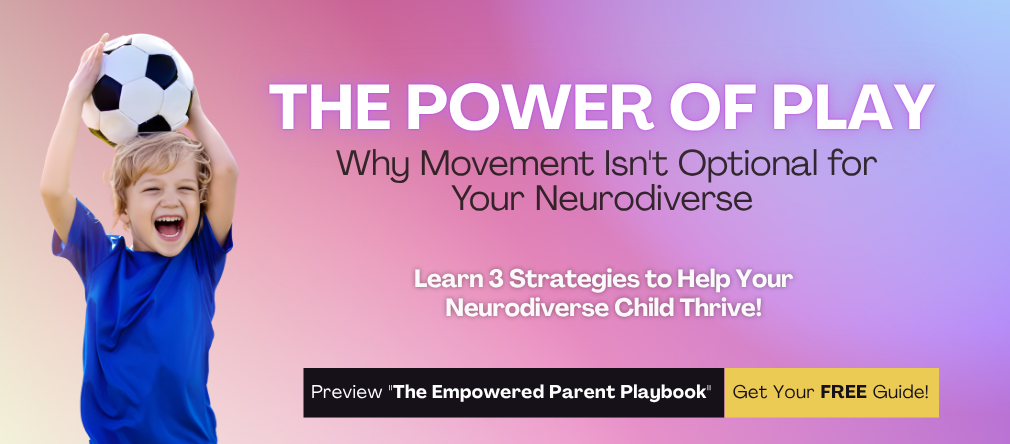
Play Builds Connection and Communication
I remember one boy who was completely nonverbal when he started therapy with me. He hated water. Refused to be touched. Couldn’t sit still long enough for even a short session.
We didn’t start with speech drills or flashcards.
We started by playing in water.
He would tentatively splash, then eventually submerge his hands, then his shoulders… and over time, something shifted. He began to smile. Laugh. Make eye contact.
One day, during a pool activity, he turned to me and made a sound.
Then another.
And then, a word.
That moment didn’t come in spite of play.
It came because of play.
When children feel safe in their bodies, when they can move and regulate and explore without fear or punishment, communication becomes possible. It’s like unlocking the gate to their nervous system, and suddenly, the lights come on.
Play Builds Real-Life Skills
I hear from so many parents who say:
“I just want my child to be able to go to the grocery store without a meltdown.”
“I want to understand what my child needs without guessing.”
“I want peace in my home.”
And while these desires are absolutely valid, the path there often begins with something far more foundational than we think: functional play.
Play helps your child develop:
Self-regulation
Spatial awareness
Social reciprocity
Communication pathways
Core strength and motor planning
These aren’t just abstract developmental terms. They translate directly into real life:
Sitting at the dinner table without fidgeting
Walking through a classroom without panic
Expressing needs without tantrums
What You Can Do Today
You don’t need a full therapy gym to get started.
You need intention, safety, and curiosity.
Try these 3 movement-based strategies at home:
Superhero Crawls – Have your child crawl under cushions or blankets to engage proprioceptive pressure.
Swing & Sing – Gentle rocking on a swing (or in a blanket hammock) while singing or naming body parts.
Jump & Count – Use pillows or taped shapes on the floor to create a jumping path while counting aloud.
These small movements, repeated often, begin to train the brain. They tell your child’s body: You are safe. You are capable. You are learning.
You Don’t Need to Do This Alone
If you’re feeling overwhelmed, I see you.
If you’re unsure what your child’s behavior really means, you’re not failing.
You just haven’t been given the tools.
That’s exactly why I created The Empowered Parent Playbook, a science-based, story-driven guide that introduces three strategies you can start using today to support your child through play, not pressure.
Curious how to use play more intentionally at home?
Preview my new book, The Empowered Parent Playbook, and learn three strategies that work.