Why I Brought Horses Into My Practice — And What They Do That I Can't
The science, the experience, and the question a parent asked me that I've never forgotten.
I have been asked a version of this question more times than I can count:
"Why horses?"
Usually it comes from clinicians who want to understand the evidence base. Sometimes it comes from parents who are skeptical that anything involving a large animal could be more effective than what they can access in a traditional therapy setting.
And occasionally — the cases that stay with me — it comes from a parent who has been on a waiting list for eighteen months, who has tried four different therapy approaches, who is watching their child struggle in ways that break their heart every morning, and who is asking the question with a quiet desperation underneath it:
Is there something else? Is there something we haven't tried yet?
For those parents, yes. There is something else. And it begins with a horse.
What Brought Me Here
I started my career as a pediatric occupational therapist and built my clinical practice on sensory integration — the work of Dr. Jean Ayres, whose foundational research mapped how the vestibular, proprioceptive, and tactile systems develop and what happens when they don't.
Over thirty years of clinical practice, I have seen what the research describes. I have seen children whose nervous systems were chronically overwhelmed, chronically understimulated, chronically operating in fight, flight, or shutdown — and who were being asked to learn, to behave, to engage, to connect, in the middle of all of it.
And I have seen what happens when the nervous system finally gets what it needs. When the sensory input is right. When the environment is safe. When the body is regulated. The child who was unreachable becomes reachable. The child who couldn't speak finds words. The child who was always in motion becomes still.
Horses were never part of my original plan. Then I started watching what happened when children got on horseback. And I couldn't ignore it.
“The horse is a co-regulator. Not a metaphor. Not a motivational aid. A living, breathing, physiologically present organism whose autonomic nervous system can synchronize with a dysregulated child's — and pull it toward calm.”
The Neuroscience I Wasn't Expecting
Here is what the research tells us — and what my clinical observation has confirmed.
A horse at walk generates a three-dimensional pelvic movement that closely mirrors human walking. When a child sits astride a horse at walk, their core receives continuous rhythmic vestibular and proprioceptive input through the pelvis and spine. This is the exact input pattern that Jean Ayres identified as foundational to sensory integration — delivered by a living, dynamic system rather than by a swing or a piece of therapy equipment.
But there's something else happening that the sensory integration framework alone doesn't fully explain.
Horses are extraordinarily sensitive to human autonomic state. They respond to heart rate variability, breathing patterns, and what Stephen Porges calls the social engagement system — the ventral vagal state of calm, safe, open connection. When a dysregulated human is in the presence of a calm horse, the horse's regulated autonomic state provides a co-regulatory signal that the human nervous system can entrain to.
This is not metaphorical. It is physiological. Heart rate variability research — particularly the work coming out of the HeartMath Institute on heart coherence — has documented this synchronization in measurable ways.
For children with autism and sensory processing disorders whose baseline autonomic state is chronically dysregulated, this is significant. The horse is not a prop or a reward. It is a co-regulator. And co-regulation — the experience of a calm, stable nervous system in proximity — is one of the most ancient and effective pathways to regulation that exists.
What Children Who Stop Talking Start Saying
I want to be careful here not to overstate what equine therapy can do. It is not a cure. It is not a replacement for OT, ABA, or speech therapy. It does not work identically for every child.
But I have witnessed things in equine sessions that I have not witnessed in thirty years in a clinic. Non-verbal children who have not spoken in a therapeutic context speaking to the horse. Children who are always in motion becoming still, absorbed, present — because the horse requires that of them. Children whose sensory systems are so overwhelmed in ordinary environments that they cannot engage with an adult finding genuine connection through the relationship with an animal that asks nothing of their language system.
The horse doesn't judge. The horse doesn't demand compliance. The horse doesn't have an agenda about what the child should be doing right now. The horse just walks. And sometimes, for a nervous system that has spent years in defense mode, that walking is exactly what was needed.
The HeartHorse Program — What We Do
The HeartHorse Program is an OT-informed, sensory integration-grounded equine-assisted therapy program for children ages four to sixteen with sensory processing differences, autism, ADHD, anxiety, and developmental delays.
Sessions are held at my property and run in small groups of three to five children. Each session follows a therapeutic arc:
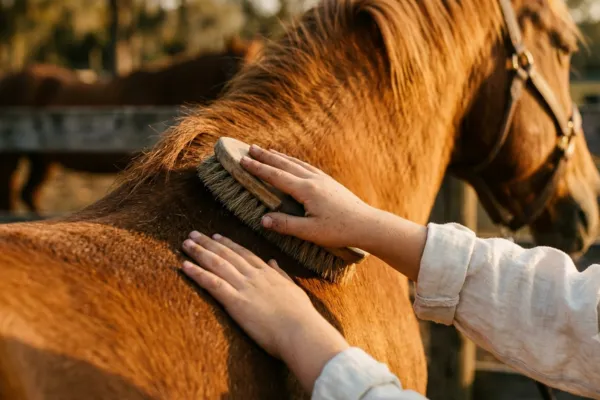
Preparation and grooming — tactile and proprioceptive input; building tolerance and relationship with the horse
Mounting — a graded motor planning and strength challenge
Walking work — the primary therapeutic input: rhythmic vestibular and proprioceptive stimulation through movement
Activities on horseback — bilateral coordination and motor planning layered onto the regulatory base
Dismounting and grounding — returning to the floor; integration
The program runs in twelve-week cycles, designed as a complete therapeutic arc from initial engagement through active work to regulation, mastery, and independence.
Who Is This Right For?
HeartHorse tends to be most effective for children who:
Have not fully responded to traditional clinic-based therapy
Struggle to engage in standard therapeutic environments — the clinical room, the therapy equipment, the one-on-one adult-led format
Are sensory seekers whose nervous systems need intense, full-body input to reach regulation
Are chronically dysregulated — whose baseline arousal is high regardless of environment
Are non-verbal or minimally verbal — the horse removes the language demand that often blocks therapeutic engagement
Have a trauma history that makes human-adult therapeutic relationships difficult
If your child has been in therapy for years without the progress you hoped for — I want to be clear that this is not a reflection of the quality of the therapists or your commitment as a parent. Some nervous systems need something different. Something that speaks a different language. Sometimes that language is a horse at walk.
“Some nervous systems need something different. Something that speaks their language before it asks them to speak ours.”
We Are Roswell, Georgia — and We Come to You Through the App
The HeartHorse Program is based in Roswell, Georgia, and serves children and families in the greater Atlanta area and North Georgia. Sessions are held at my property, in small groups, using the full OT-informed equine-assisted therapy framework.
If you are outside the Roswell area and looking for equine therapy for your child, I would encourage you to seek a PATH International certified equine specialist or center in your region. The principles are universal even if the practitioner is different.
And if you're looking for sensory support that you can access right now, regardless of where you live, the Sensory Pathways App brings the clinical framework I've built over thirty years to any home, any backyard, any budget.
The horse is the most extraordinary sensory tool I have ever used. But the nervous system work belongs to every child — not only the ones who can get to Roswell.