The Model I've Been Using for 30 Years That Changes How Parents See Their Child's Behavior
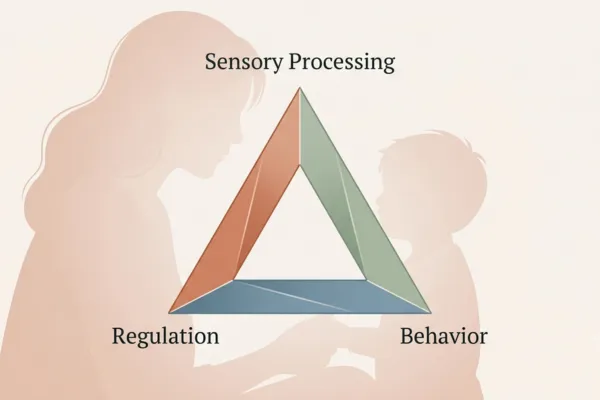
A simple triangle. Three corners. And a way of understanding your child that no one ever taught you.
I have been in this field for thirty years. I have sat with thousands of families — at clinic tables, in school hallways, in therapy gyms, on the phone at 8 o'clock at night when something has gone wrong and a parent doesn't know what to do.
And in all of that time, one thing has remained constant. The moment a parent understands the triangle, something shifts.
Not just in how they think about their child. In how they feel about their child. In how they feel about themselves as a parent.
So today I want to give you the triangle.
“Most families aren't struggling because they're doing something wrong. They're struggling because no one ever taught them the language their child's body is speaking.”
What Is the Triangle Corner Model?
The Triangle Corner model is a way of understanding how three systems work together — or against each other — in a child's nervous system. It's not complicated. You don't need a clinical background to understand it. In fact, that's the whole point.
The three corners of the triangle are:
Sensory Processing — how the brain receives and interprets information from the body and the environment
Regulation — the nervous system's ability to manage its own level of arousal: calm down when it's overwhelmed, alert up when it's understimulated
Behavior — what we see on the outside when the first two aren't working well together
Most people — most parents, most teachers, most people who work with children — are only ever shown the third corner. The behavior. What the child is doing. What the child won't do. Whether the child is compliant or difficult or stuck or explosive.
The triangle asks us to zoom out.
Becausse behavior is always the last thing that happens. It is the output of everything going on beneath the surface — the sensory experience the child is having in this moment, and whether their nervous system has the tools to manage it.
The Sensory Corner: What's Actually Coming In
Every minute of every day, your child's brain is receiving a flood of information. Touch. Sound. Movement. Light. Temperature. The pressure of their clothes. The sound of the air conditioning. The way the chair feels under their legs. The smell of someone's lunch. The brightness of the classroom window.
For most of us, the brain filters this flood automatically. We don't consciously notice most of it. Our nervous system decides what matters and what doesn't, and we move through the world without being overwhelmed by every piece of sensory information we encounter.
For children with sensory processing differences, this filtering system works differently. Some information comes in too loud, too strong, too overwhelming — and the child experiences it as genuinely threatening even when the actual stimulus is completely ordinary. The tag on their shirt. The buzz of a fluorescent light. The way someone is breathing too close to them.
Other children have the opposite experience: information doesn't come in clearly enough. They need more. More movement. More pressure. More intensity. More sensation — just to feel regulated, grounded, present.
Neither of these experiences is a behavior problem. They are sensory experiences. And until we understand what the first corner of the triangle looks like for your specific child, we cannot make sense of what we're seeing in the third corner.
The Regulation Corner: The Nervous System's Real Job
The middle of the triangle is regulation. This is the nervous system's job: to keep the body in a state where it can function, engage, learn, and connect.
We talk about regulation like it's a behavior skill. Like it's something you teach a child to do the way you teach them to tie their shoes. And while there are regulation strategies — breathing, movement, sensory input, rhythm — regulation is fundamentally neurological before it is behavioral.
A child who is dysregulated is not choosing to be difficult. Their nervous system is in a state where it cannot do what we're asking it to do. The alarm is going off. And when the alarm is going off, the reasoning brain — the part that can follow instructions, consider consequences, make good choices, and respond to correction — goes offline.
This is not a metaphor. This is neuroscience.
When we respond to a dysregulated child with correction, consequence, or reasoning, we are speaking to a brain that literally cannot hear us right now. Not because the child is defiant. Because the nervous system is in survival mode.
“Regulation is neurological before it is behavioral. A dysregulated child isn't choosing to be difficult — their alarm is going off. And when the alarm is going off, the reasoning brain goes offline.”
The Behavior Corner: The Last Thing That Happens
Behavior is the corner that everyone sees. The meltdown. The refusal. The shutdown. The hitting. The running. The child who cannot sit still, who cannot follow instructions, who seems like they're not listening, who is always in trouble, who is exhausting every adult in their life.
When we only look at the behavior corner, we ask the wrong questions. Why won't they just stop? Why can't they control themselves? What are the parents doing at home? Why isn't the punishment working?
When we look at all three corners together, different questions emerge. What is this child's nervous system experiencing right now? What does their sensory profile tell us about what they need in this moment? What is making it hard for them to regulate — and what would help?
These are not soft questions. They are clinical questions. And they are the questions that actually lead to change.
How to Use the Triangle With Your Own Child
Here's how I ask parents to start using this model at home.
Step 1 — Notice, don't react
When your child's behavior escalates, pause. Instead of immediately responding to what you see, ask: what might be happening in the first two corners right now? What is their sensory system experiencing? Is their nervous system overwhelmed, understimulated, or losing regulation?
Step 2 — Know your child's profile
Every child has a sensory profile — a unique pattern of how their nervous system receives and processes information. Understanding your child's specific profile tells you what kind of sensory input is most likely to trigger overwhelm, and what kind of input helps them regulate. This is the foundation of everything. If you haven't done the Sensory Profile Quiz yet, start there.
Step 3 — Meet the need before you address the behavior
This feels counterintuitive to almost every parent I work with. We're trained to believe that responding to behavior first — correcting it, redirecting it, consequencing it — is what changes it. But for sensory-based behavior, the nervous system has to be regulated before the child can respond to anything else. Meet the sensory need first. The behavior conversation comes after.
Step 4 — Build the sensory diet
A sensory diet isn't a meal plan. It's a schedule of intentional sensory input throughout the day that keeps the nervous system in an optimal state — not overwhelmed, not understimulated, but alert, regulated, and ready. When the sensory diet is consistent, the number and intensity of behavioral episodes typically drops significantly. Not because the child has learned to behave. Because their brain is finally getting what it needed to function.
The triangle doesn't explain everything. There are layers of complexity in every child's presentation — diagnosis, trauma history, developmental level, family context — that require individualized clinical work. But as a lens through which to start seeing your child differently, I have watched this model transform parent relationships with their children in a way that nothing else comes close to.
When you understand what's happening in all three corners, you stop fighting the behavior. You start working with the nervous system.
And that changes everything.