What Sensory Gyms Can Do That Most Therapy Clinics Can't
The case for movement-based, play-driven sensory support — and why the gym setting uniquely enables it.
I want to tell you something that might surprise you coming from an occupational therapist who has run clinical practices for thirty years.
A well-run sensory gym — with the right programming, the right equipment, and the right understanding of what's happening neurologically — can produce therapeutic outcomes that my clinic cannot.
Not because the gym is better than the clinic. But because the gym is different in ways that matter enormously for certain children.
The Motivation Problem in Traditional Therapy
In a clinical OT setting, the therapeutic intent is visible. The child knows, at some level, that they are there to work on something. This is not necessarily a problem — many children thrive in structured clinical settings. But for a significant subset of neurodiverse children, particularly those with autism and high anxiety profiles, the clinical context itself becomes a barrier.
The white room. The evaluation table. The adult with the clipboard. These things activate the sympathetic nervous system — the fight/flight response — in children who have learned through experience to associate unfamiliar environments with demands they may not be able to meet.
A child whose nervous system is in fight/flight cannot learn. They cannot integrate. They cannot respond to therapeutic input the way the research says they should — because the research assumes a regulated nervous system as the starting condition.
A sensory gym does not look like therapy. It looks like adventure.
“Children don't learn from adults who tell them what to do. They learn from experiences that make them want to try, try again, and try harder.”
— Dr. Shelley Margow
Why Story Changes the Therapeutic Equation
The adventure structure I built into the Sensory Play program is not decoration. It is a clinical tool.
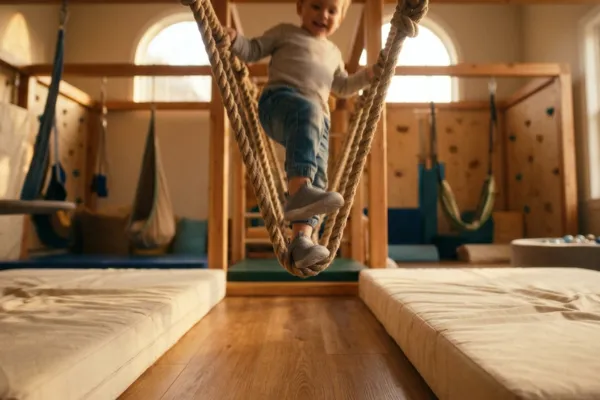
When a child is told to walk across a rope balance bridge, their nervous system evaluates the request through a lens of risk. It may trigger avoidance — in children for whom vestibular input is genuinely dysregulating, the bridge can feel threatening in a real physiological sense.
But when a child is a pirate crossing a rope bridge over shark-infested water — suddenly the vestibular challenge is embedded in a motivation structure so powerful that it overrides the avoidance response. Not in every child, not immediately, but in many children who would never have crossed that bridge in a clinical context.
The story provides context. Context provides meaning. Meaning provides motivation. And motivation — in the context of sensory work — is not a nice-to-have. It is a neurological prerequisite.
Children who are genuinely motivated to complete a physical challenge access higher levels of motor planning and proprioceptive engagement than children who are complying with an adult's request. The brain is literally doing more work — better work — when the child wants to be there.
The Group Effect — Social Engagement as a Regulatory Tool
There is something that happens in a group of children doing a sensory adventure together that cannot be replicated in a one-on-one clinical session. Polyvagal theory calls it co-regulation through social engagement. Clinically, I call it the best recruiting tool the therapeutic process has.
When a child sees another child cross the rope bridge with visible joy — when they hear the laughter from the tunnel, when they watch someone launch off the slide — their mirror neuron system activates. Their social engagement system comes online. Their nervous system begins to receive a different message: this environment is safe. This is something to move toward, not away from.
Children who refused the bolster swing in week one will attempt it in week three because they've watched their peers on it for two sessions. That's not peer pressure. That's co-regulation — the most ancient and efficient regulatory system the nervous system has.

Repetition — The Underrated Superpower of the Gym Model
One of the things I said in a recent strategy session that I want to commit to writing, because it goes against what most parents expect:
The best sensory gym program is the same program, repeated.
When I was doing intensive work with children in my clinic — two to three hours a day, four to five days a week — I would use the same story, the same characters, the same obstacle course sequence every single day. For weeks. Sometimes for months.
Parents would ask me: "Don't they get bored?" And I would say: watch them.
Because what happens across repeated exposures to the same sensory sequence is not boredom. It is mastery. The first week, the child is uncertain at the rope bridge. The second week, they hesitate less. The third week, they cross. The fourth week, they tell the newer child how to do it.
That progression — from avoidance to mastery to teaching — is exactly what neural integration looks like from the outside. And it happens faster and deeper when the structure is familiar, because the brain is not spending energy on novelty processing. It can spend that energy on the sensory work.
Novelty is engaging. Mastery is transformative.
What the Gym Setting Uniquely Enables
Let me be specific about what a sensory gym offers that a clinical setting often cannot:
Scale — one well-designed program serves multiple children simultaneously, without requiring one therapist per child
Normalization — children are in a shared space, not a therapy room; the social context reduces shame and stigma
Duration — a 45-60 minute session provides a deeper regulatory arc than a 45-minute one-on-one clinic session, because the child is moving continuously
Consistency — weekly sessions with the same story and equipment build the repetition that neural integration requires
Parent education — parents watching the session learn what their child's sensory system needs in a way that no handout can replicate
Accessibility — at a fraction of the cost of private OT, sensory gyms can serve families who would otherwise have no access to therapeutic support
None of this means that sensory gyms replace clinical occupational therapy. They don't. For children with complex needs, direct OT evaluation, treatment planning, and 1:1 intervention remains essential. But for the enormous population of children who need regular, consistent sensory motor experience and whose families cannot access or afford weekly private therapy — the gym is often the best available option.
And when the gym has a program that understands what it's doing neurologically — that knows why the session is sequenced the way it is, why the platform swing is always last, why the same story runs for four weeks in a row — that gym is doing something genuinely therapeutic.
“You don't have to be a therapist to run a therapeutic session. You have to understand what the experience does to the nervous system — and then create the conditions for it to happen.”
A Note to Gym Owners
If you own or manage a sensory gym and you've read this far, I want to say something directly to you.
You are doing something important. The children who walk through your doors are not there for recreation. They are there because their nervous systems need something that most environments don't provide. Movement. Challenge. Repetition. Safety. Joy.
The Sensory Play program exists to give you the clinical framework to make those sessions as therapeutically valuable as possible — without requiring a therapy license, a clinical team, or a six-figure budget.
Use the story structure. Trust the sequence. Let the platform swing do its work at the end. Run the same adventure for four weeks. Watch what happens.
The children will show you. They always do.