What Every Teacher Should Know About the Sensory Brain
If you’re a teacher, you’re doing a lot.
You navigate lesson plans, classroom management, behavior, academics – all while caring for dozens of unique children every day.
But there’s something many teachers are never trained to understand:
Behind behavior, behind “distraction,” behind “defiance,” there often lies a nervous system, a sensory brain, that’s asking for help.
I know you didn’t go to school to become a therapist and I want to bridge that gap for you. I’ve been a pediatric occupational therapist for over twenty years and have spent my career helping children with their sensory brains.
I created this guide with you in mind: a beginner’s overview of the sensory brain. My hope is that by the end, you’ll see your students through a different lens: one that notices regulation before reaction, and support before discipline.
What Is the “Sensory Brain”?
Your brain receives input through many “senses,” not just sight and hearing, but movement, balance, body awareness, touch, internal sensation, and more.
For simplicity in classrooms, two systems often matter most:
Vestibular System - This is your body’s balance and motion system. It helps you know when you’re moving, spinning, tilting, standing, falling, and tells your brain how to orient in space.
Proprioceptive System - This is your “body awareness” sense: where are your arms, legs, spine, head? How much muscle and joint pressure you feel. It’s how you know how hard to push a pencil, how much weight you carry, how stable you feel when you stand.
Together, plus touch, sound, vision, smell, internal cues, these make up a child’s sensory experience. When those systems are not regulated, the brain has trouble focusing, learning, or even staying calm.
In other words: a child’s behavior isn’t just a choice. Sometimes, it’s a nervous system response.
Why Many Students Seem “Distracted,” “Overactive,” or “Shut Down”
When a child’s sensory system is overstimulated, under-regulated, or out of balance, you might see:
Constant movement, fidgeting, rocking, climbing because the vestibular system is under-responsive and hungry for input
Crashing, jumping, banging - seeking heavy pressure or proprioceptive input to ground themselves
Avoidance of touch, tags, textures, loud sounds, bright lights because their sensory receptors are over-sensitive
Shutdowns, freezing, shutdown meltdowns when the system can’t handle more and the brain goes to protection mode
Difficulty focusing during seated tasks, handwriting, waiting because their body is “demanding” regulation, but the classroom requires stillness
None of these behaviors needs to be labeled “bad behavior.”
They are signs. Signals. Clues that something in the sensory system is speaking, and the child needs support.
What Teachers Can Watch For: Early Signs of Dysregulation
You don’t need special equipment to notice sensory distress. With a bit of awareness and observation, you can catch patterns that help you respond better.
Here are early signs to watch for:
Frequent fidgeting, tapping, squirming, shifting in seats
Students always touching walls, desks, chairs, leaning, stretching, as if they need extra pressure
“Accidental” bumps, knocks - children crashing into desks or friends without meaning to
Difficulty entering or leaving class, or visible anxiety around transitions
Overreaction (meltdowns) to loud noises, echoes, crowded corridors, bells, or even certain lighting
Sudden shutdowns - spaced-out stares, unresponsiveness, extreme quiet or withdrawal
Avoidance of group work, downloads of attention, or inability to remain seated for short tasks
When you see one or more, try not to judge. Try to notice. That shift in perspective can open the door to support instead of punishment.

Simple Classroom Adjustments That Make a Big Difference
You don’t need a therapy gym or extra funding to help. These small, intentional changes can drastically improve how a sensory child experiences your classroom:
1. Routinely build in movement
Short movement breaks (every 30–45 minutes): stretching, wall push-ups, marching in place, walking tasks
Use “movement stations”: a corner with stretchy bands, or space near a wall for gentle wall pushes; both proprioceptive activities
Alternate sitting tasks with standing or “perimeter work” (erasing board, handing out papers, cleaning chalkboard)
2. Provide a “safe regulation zone”
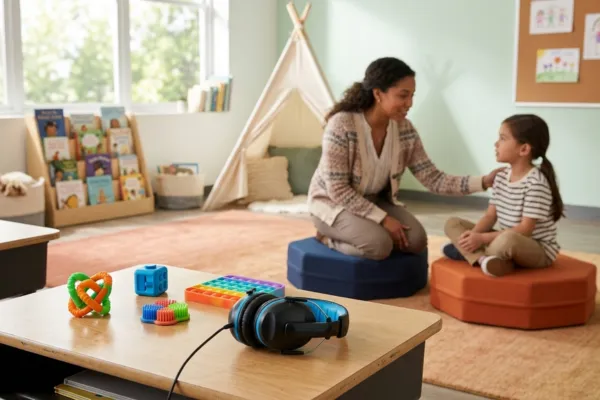
A small corner or quiet area, with soft seating (bean-bag or floor mat), headphones, fidgets, maybe soft dim lighting or a “calm-down kit”
Allow children to access it voluntarily when feeling overwhelmed; not as punishment, but as self-regulation
3. Offer choices beyond “sit still”
Instead of requiring all sit-down learning, offer options: read standing up, draw on whiteboard, use floor cushions, or use wobble seats
For handwriting tasks, offer alternatives like typing, verbal responses, or drawing
4. Use visual schedules & clear transitions
Ahead-of-time warnings before transitions: “In 2 minutes, we switch to reading.”
Use visual icons for tasks. This helps lessen auditory or processing overwhelm
5. Normalize “sensory breaks” for the whole class
Frame breaks as brain resets, not as special privileges
Explain to the class: “We all need to move sometimes so our brain can focus better.”
Encouraging this normalizes sensory needs as human, not as deficits
Why This Matters: For Students and Educators
When classrooms shift from “manage behavior” to “support sensory brains,” both children and teachers win:
Fewer meltdowns - because children get what their nervous system needs before overload occurs
Improved focus & learning - when the body is regulated, the mind can engage
Increased inclusion - children previously labeled “disruptive” become simply learners with different needs
Teacher relief & reduced burnout - fewer behavior crises, fewer discipline moments, more predictable class flow
You didn’t sign up to be an enforcer.
You signed up to teach, to guide, to help children grow.
Understanding the sensory brain helps you do exactly that, but gently, compassionately, and effectively.
Final Thought: It’s Not About Perfection. It’s About Awareness
You don’t need to transform your classroom overnight.
You don’t need a diagnostic label, special license, or perfect plan.
You only need curiosity and compassion.
See the child behind the behavior. Notice the nervous system behind the reactions. Respond with support, not shame.
Because when we start from regulation, everything else becomes possible.
Want A Practical Tool to Get Started?
Download the free Sensory Checklist for Educators – a simple, easy-to-use tool to help you observe, reflect, and respond to your students’ sensory needs before they escalate.
Use it to track patterns, build student support plans, and foster a classroom culture of understanding rather than control.
Get the Sensory Checklist for Educators Here
Let’s shift classrooms… one understanding teacher, one regulated child, one calm class at a time.