Kids Have Forgotten How to Play — And It's Affecting Their Brains
What the post-COVID play deficit is doing to children's nervous systems, and what we can do about it.
In 2020, I turned to my husband and said something I hoped I was wrong about. The world had just shut down, playgrounds were closed, and children were learning to interact with screens instead of each other, instead of their bodies, instead of the world.
I said: "We are going to see an exciting generation of children who don't know how to play."
I wasn't wrong. And what has followed is not just a social problem. It is a neurological one.
“Play is not a luxury of childhood. It is a biological necessity.”
— Dr. Shelley Margow, OTD, BCBA
What We Mean When We Say Children Don't Know How to Play
I want to be precise here, because this is not about screen time lectures or nostalgia for simpler times. When I say children have forgotten how to play, I mean something specific and measurable.
Play — real play, the kind that involves bodies moving through space — is the primary driver of sensory motor development in early childhood. When a child climbs, rolls, hangs, jumps, crawls, and crashes, they are not just having fun. They are building their nervous system.
Every sensory experience through movement feeds the brain information about:
How the body is positioned in space (proprioception)
How the body is moving and balancing (vestibular processing)
How surfaces, textures, and objects feel (tactile discrimination)
How to plan and execute a sequence of physical movements (motor planning)
How to regulate arousal — when to be alert, when to settle (sensory modulation)
When children spend years primarily sitting, watching screens, and engaging in minimal physical interaction with their environment, these systems don't develop the way they need to. The brain's regulatory networks — the very networks that govern attention, emotional regulation, social engagement, and learning — are shaped by sensory motor experience. Without it, they are underdeveloped.
What I'm Seeing in the Clinic
Since 2020, the patterns I'm seeing in the children who come through my clinic have shifted. The referrals for autism haven't changed — autism rates were already rising before the pandemic, and that trend has continued. But the children coming in without formal diagnoses who are struggling have increased significantly.
Children who are six, seven, eight years old and who have never learned to pump their legs on a swing. Children who flinch at unexpected touch because their tactile system has never been adequately challenged. Children who cannot sit still for a meal — not because of behavioral problems, but because their proprioceptive system has never developed the postural stability to sustain sitting without fidgeting.
These are not bad kids. These are not lazy parents. These are children whose developmental window for sensory motor learning was significantly disrupted — and whose brains are now working overtime to compensate.
In Milledgeville, where I recently opened a new clinic location, I met a mother who is a special educator. She has a five-year-old with autism and lives in a rural area with essentially no OT access. One speech therapist for the entire district, with a waiting list so long she'd given up. She asked me a very simple question.
"Will it tell me what to do with my child?"
That question has stayed with me. Because the answer should always have been yes. The information exists. The research exists. The tools exist. What has been missing is access.

Why Play Can't Be Replaced by Screens — Or Even Structured Lessons
I want to address something I hear often: "My child is very active. They do swimming lessons and soccer. Isn't that enough?"
Structured physical activities have real value. But they are not a substitute for unstructured, self-directed sensory play, and here's why.
In a swimming lesson, a child follows instructions. In unstructured play, a child initiates. That difference matters enormously to the brain. Self-directed movement — choosing to climb the tree, deciding to jump off the rock, figuring out how to squeeze through the gap — activates the motor planning pathways of the prefrontal cortex in ways that following a coach's directions does not.
Adventure play, messy play, rough-and-tumble play, and physical exploration are irreplaceable. They are how children have built nervous systems for the entirety of human history.
And for a period of several years, many children were deprived of exactly this.
“When children play the way children have always played, the brain builds itself. We don't have to engineer that. We just have to stop blocking it.”
What We Can Do About It — Right Now
The good news is that the brain is plastic. Neuroplasticity — the brain's ability to reorganize itself in response to experience — means that it is never too late to provide the sensory motor experiences children missed. The window is not closed. It is just narrower, and it requires intentionality.
Here's what that looks like in practice:
For parents at home:
Turn off the screen and create unstructured outdoor time — even 30 minutes a day of climbing, running, and rolling makes a measurable difference
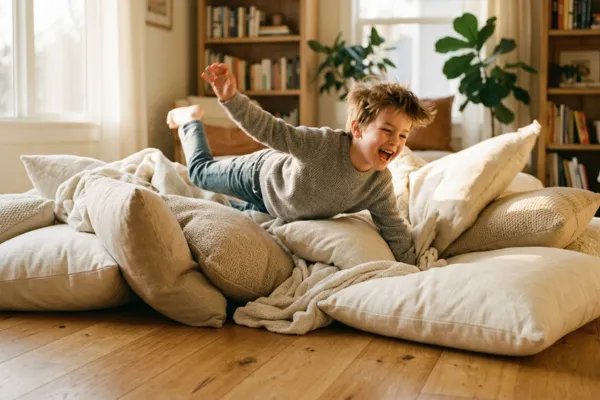
Bring sensory play indoors: a couch cushion crash pit, a blanket fort, a box of kinetic sand or shaving cream
Allow rough-and-tumble play — wrestling, pillow fights, and physical play between siblings is developmentally important, not dangerous
Prioritize movement before tasks: jump 20 times before homework, swing before dinner
For gym owners and educators:
Understand that children who seem to "not know how to play" are not behavior problems — they are sensory-deprived nervous systems that need patient, structured engagement
Start simple. Stepping stones. A rope bridge. A slide. The adventure structure itself provides the scaffold that children who lack play experience need
Repetition matters more than novelty. The same story adventure for three to four weeks builds genuine neural integration. This is not boredom — it is mastery.
We are not going to un-ring the bell of the pandemic. But we can be intentional about rebuilding what was lost. The children coming into sensory gyms and clinics today are not behind. They are waiting for the experiences their brains have been asking for.
Give them the adventure. The brain will do the rest.