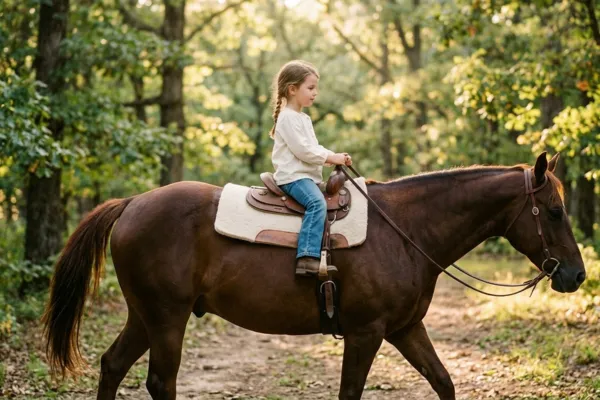
Why Horses Are One of the Most Powerful Sensory Regulation Tools We Have
The neuroscience behind equine-assisted therapy — and what it can do for children that traditional settings often can't.
Of all the therapeutic modalities I've worked with over thirty years, few have the immediate, visible, and consistent regulatory effect on children's nervous systems that horses do.
I've watched children who have barely spoken in a therapy session communicate freely with a horse. I've seen children who are in constant motion — climbing, crashing, seeking — become still and quiet on horseback in a way I couldn't achieve with any other intervention in that same session. I've seen the posture change, the breathing slow, the eyes soften.
For a long time, I had the clinical observation but not the full neurological explanation. The research has caught up, and what it reveals is extraordinary.
What Horses Do to the Nervous System
The horse's gait — at walk — generates a rhythmic, three-dimensional pelvic movement that closely mimics human walking. When a child sits astride a horse at walk, their core is receiving continuous, rhythmic vestibular and proprioceptive input through the pelvis and spine.
This is not incidental. This is the specific input pattern that the vestibular system uses to build postural stability, body awareness, and the ability to regulate arousal. It's the same input Dr. Jean Ayres identified as foundational to sensory integration therapy in the 1970s — but delivered by a living, moving animal rather than a suspended swing.
The regulatory effect is measurable. Research from Gabriels et al. (2015) found that children with autism who participated in therapeutic horseback riding showed significant improvements in irritability, hyperactivity, and social cognition compared to a control group. Studies measuring cortisol levels in children after equine-assisted sessions consistently show a reduction in physiological stress markers.
“The horse is a living, dynamic regulatory stimulus. It provides naturalistic rhythmic vestibular input, immediate social feedback, and genuine motivation to engage — all simultaneously.”
— Dr. Shelley Margow
The Heart Coherence Connection
There is something else happening in equine therapy that has taken longer to understand, and it sits at the intersection of neuroscience and something that can only be described as relational.
Horses are extraordinarily sensitive to the autonomic state of the humans near them. They respond to heart rate variability, breathing patterns, and what polyvagal researchers call the "social engagement system" — the ventral vagal state of calm, open, safe connection that allows learning and relationship to happen.
Research in heart rate variability and what the HeartMath Institute calls "heart coherence" has found that when human and horse are in close proximity, their autonomic systems can synchronize. This is not metaphorical. It's physiological. A calm horse in the presence of a dysregulated child literally provides a regulatory signal that the child's autonomic nervous system can entrain to.
For children with autism, ADHD, and sensory processing disorders — children whose autonomic regulation is often dysregulated at baseline — this is significant. The horse is not just a novel stimulus or a motivating prop. It is a co-regulator.
Polyvagal Theory and Why Horses Access It
Stephen Porges's Polyvagal Theory describes the autonomic nervous system as operating in a hierarchy:
Ventral vagal (social engagement, safety, connection) — where learning, relationship, and regulation happen
Sympathetic (fight/flight) — where hyperarousal and overwhelm live
Dorsal vagal (shutdown, freeze) — where withdrawal and disconnection occur
Children with autism and sensory processing disorders frequently operate from the sympathetic or dorsal vagal state — even in safe environments — because their nervous systems have learned to anticipate threat from sensory input that others barely notice.
What horses do — what the movement, the warmth, the breath, the smell, the rhythmic walking provides — is a pathway back to ventral vagal engagement. Not through instruction. Not through cognitive processing. Through the body. Through the oldest regulatory system the nervous system has.
Children who are unreachable in a classroom or a clinic are sometimes profoundly reachable on horseback. This is why.

What Equine Therapy Looks Like in Practice
I want to be clear that therapeutic horseback riding and equine-assisted psychotherapy or occupational therapy are different things, and the research base and clinical protocols differ between them. What I'm describing is the OT-informed, sensory integration framework applied within an equine context.
In my practice, sessions typically include:
Preparation and grooming — tactile and proprioceptive input before mounting; building tolerance and connection
Mounting — a graded challenge that requires motor planning, strength, and coordination
Walking work — the primary therapeutic input; rhythmic vestibular and proprioceptive stimulation through movement
Activities on horseback — reaching, throwing, catching; bilateral coordination and motor planning layered onto the regulatory base the movement provides
Dismounting and grounding — the integration phase; returning to the ground after sensory input
A 75-minute session in this framework — the structure I'm using in my equine program at my property — provides a therapeutic arc comparable to a full clinical OT session. The regulatory depth is remarkable.
Who Benefits Most
Equine-assisted therapy has the strongest evidence base for children with autism, ADHD, sensory processing disorder, anxiety, and trauma histories. The vestibular and proprioceptive inputs are particularly beneficial for children who are:
Sensory seekers — the Crash & Play Kids who need intense input to feel organized
Chronically dysregulated — children whose baseline arousal is high regardless of environment
Non-verbal or minimally verbal — the horse requires no language to communicate with, removing a barrier that often interferes with therapeutic engagement
Resistant to traditional clinic settings — children who cannot tolerate standard therapy rooms often thrive in outdoor, movement-rich equine environments
This is not a replacement for OT, ABA, or speech therapy. It is a powerful complement — one that can open neurological doors that other modalities cannot.
“The most profound regulatory experiences I have ever witnessed in 30 years of clinical practice have happened on horseback. The horse doesn't judge, doesn't rush, and doesn't ask for compliance. It just walks. And sometimes, that walking is exactly what a nervous system needs.”
Coming Soon: Equine Therapy at Our Practice
I am launching a 12-week equine therapy program for children ages 4-16 with sensory processing differences, autism, and related diagnoses. Sessions are held at my property, in small groups of 3-5 children, using an integrated OT-informed framework. Programs are designed as 12-week packages with a flexible weekly payment option.
If you're interested in learning more — for your own child, or to discuss whether equine therapy might be appropriate for a child you work with — reach out directly.