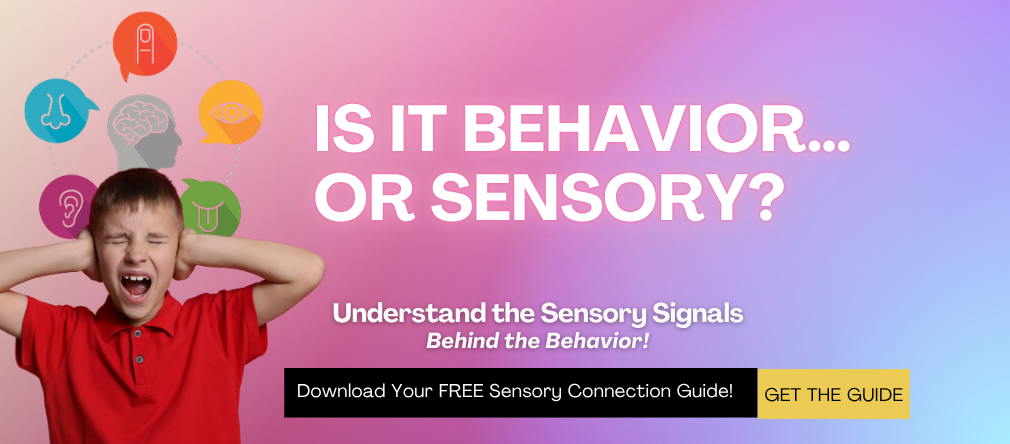
Is It Behavior… or Sensory?
How to Decode What Your Child Is Really Communicating
When a child melts down in a store, refuses to wear their clothes, or won’t use the bathroom, the default assumption is often: “They’re acting out.”
But what if it’s not defiance at all?
What if it’s the body, the nervous system, trying to scream:
"I’m overwhelmed. I don’t feel safe."
This is the shift I’ve helped families make for over 30 years.
And when you see the world through your child’s sensory lens, everything begins to make more sense.
What Is Sensory Processing?
Your child’s nervous system is constantly collecting and sorting information:
From lights. Sounds. Movement. Smells. Touch. Balance. Even internal sensations like hunger or body position.
For most children, the brain organizes this input easily.
But for some, that system gets overwhelmed, or under-stimulated. We call this Sensory Processing Difference (SPD).
And when the nervous system gets flooded, your child might react in ways that look like "bad behavior," but are really signals of distress.
Imagine This:
You're asked to sit still in a chair while:
A fire alarm is going off above your head
A bright strobe light flashes in your face
You’re wearing clothes that feel like sandpaper
Someone tells you to “just calm down”
Could you?
This is what a typical school day can feel like for a child with sensory sensitivity.
Their “outburst” is not disobedience, it’s survival.
Behavior or Sensory Response? Here’s How to Tell:
So how can you tell the difference between a behavioral issue and a sensory response? Start by observing the patterns.
For example, if your child often has meltdowns in public places like grocery stores or malls, it may not be about "bad behavior," they could be overwhelmed by the sounds, bright lights, or crowded spaces.
If they avoid wearing certain clothes or shoes, it might be due to tactile sensitivity, things like itchy tags, seams, or fabric textures that feel unbearable to their nervous system.
Children who frequently run into furniture or crash into people may actually be seeking proprioceptive input, a way of grounding themselves in their own bodies.
Refusing to use the bathroom? That could be related to sensory aversions like the echo in the room, the sound of the flush, or the feeling of being confined in a small space. And if your child can’t seem to sit still, it may be less about defiance and more about an under-responsive vestibular system, a need for more movement in order to feel balanced and regulated.
When you begin to interpret these signals through a sensory lens, everything changes… especially how you respond.
Now ask yourself:
When does the behavior happen? What happens right before it? What helps your child calm down?
These are clues. Sensory clues.
Case in Point: The Boy Who Wouldn’t Use the Toilet
A few years ago, I worked with a bright, verbal 4-year-old who refused to use the toilet.
Not at home. Not at school. Nowhere.
After several intensive sessions, and building safety through sensory regulation and trust, he finally told us the truth:
“I’m scared I’m going to fall in.”
It wasn’t about behavior. It was about fear, balance, and the sensory overwhelm of a bathroom. Once we addressed the real need and integrated sensory tools, he was able to go to the bathroom, start school, and thrive.
That’s the power of listening beneath the behavior.
Why Labels Miss the Mark
When we call something “attention-seeking,” “lazy,” or “oppositional,” we shut down curiosity.
We miss the communication behind the reaction.
In reality, most kids aren’t trying to “get away with something.”
They’re trying to get away from something: discomfort, overwhelm, pain, confusion.
What they need is co-regulation, not punishment.
They need structure and compassion, not shame.
What the Research Shows
Studies continue to confirm the deep link between sensory processing and behavior:
90% of autistic children show sensory processing challenges that directly affect their mood, function, and learning. (Robertson & Baron-Cohen, 2017)
Sensory sensitivities can impact language, attention, and emotional regulation, even in kids without an autism diagnosis. (Ben-Sasson et al., 2009)
When sensory needs are supported, behavioral outbursts and school disruptions dramatically decrease. (Baranek et al., 2015)
That’s why treating the sensory system is not optional.
It’s fundamental.
What You Can Do Today
If you’re wondering whether your child’s behavior might actually be a sensory signal, here’s where to begin:
Observe Patterns
Keep a short log of what happens before, during, and after a meltdown. What were the sounds, textures, transitions?Create a Regulation Toolkit
Offer calming input: swings, weighted blankets, fidgets, deep pressure, music, quiet corners.Simplify Language
Use clear, calming phrases. Reduce demands during distress. Invite connection before correction.Validate and Reassure
"Your body is telling us something. I’m here to help." That one sentence changes everything.Use My Free Sensory Checklist
It’s a gentle way to start identifying what your child might be experiencing — and how to help.
Final Thought
Your child is not broken.
They are not trying to make your life harder.
They are trying to feel safe in a body, and world, that often doesn’t make sense to them.
And you don’t have to figure it out alone.
That’s why I created the Sensory Connection Guide to help parents like you make sense of what you're seeing and give your child the support they need.
Start understanding your child’s sensory profile, and build a calmer, more connected relationship.